The Asian Aspiration by Greg Mills & Olusegun Obasanjo & Hailemariam Desalegn & Emily van der Merwe
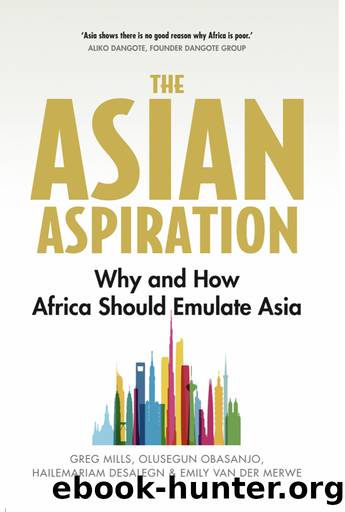
Author:Greg Mills & Olusegun Obasanjo & Hailemariam Desalegn & Emily van der Merwe
Language: eng
Format: epub
Publisher: Hurst
Published: 2020-08-15T00:00:00+00:00
The Shanghai effect
The basis of post-feudal modern China was cemented by the role of Sun Yat-sen. Influential in overthrowing the Qing dynasty in 1911, he had been born to poor farming parents. After a period abroad, Sun forsook his career as a doctor in 1894 to seek political fortunes, troubled by the way China had been humiliated by the technologically superior colonial powers. A 16-year exile followed a failed uprising in Guangzhou. Based in Japan, he founded the United League and continued to mobilise against the Qing regime. After a period of instability, Sun installed himself as generalissimo in 1923 until his death from cancer in 1925. He is still a symbol of Chinese modernisation.
When Sun came to Shanghai in 1912, he and his family set up house in a two-storey Western-style building in the former French concessionary area of the city. Even by his global standards, he would have found it a very modern, cosmopolitan city.
Once a small fishing village on the Huangpu River, Shanghai developed during the late Qing dynasty as a trading port. In 1842, following their victory in the First Opium War, the British opened a concession in Shanghai. Thereafter, the city entered a period of growth and transformation interrupted only by the Mao regime. French, American and Japanese concessions soon followed that of Britain.
By the 1930s, Shanghai had developed into the most important port and most modern city in Asia, as notorious for its licentious character as it was famed for its banks and business. Known as âthe wicked old Paris of the Orientâ, with âas vivid a cast of chancers, schemers, exhibitionists, double-dealers and self-made villains as had ever been assembled in one placeâ, the city was âboth glamorous and squalid, extremely rich and poor, unscrupulous and toughâ.20 Street names in Shanghaiâs Old City â Honglangan Jie (âstreet of the red banistersâ) and Hongzhuang Nong (âred hamlet laneâ) â invoke not the colours of Marxism-Leninism but the brightly painted facades of the legal and ubiquitous brothels. âTit-pinch laneâ, Monai Nong, was narrow enough, as the name suggests, to provide pedestrians with groping opportunities.21 The term, to âshanghaiâ, lower case, now means to coerce or scam.
It was a city of what were, by the standards of the time, stunning mod cons. The Astor House Hotel was established in 1846 as Richardsâ Hotel and Restaurant near the confluence of the Huangpu River, where it remains. Enjoying the reputation as the finest hotel in China â Albert Einstein, Charlie Chaplin and Zhou Enlai have all stayed there â this was the site of the debut of the first telephone, first electric lamp and talking movie in China. The Peacock Hall ballroom was once the site of the Shanghai Stock Exchange.
The cityâs rise came on the back of commerce, but of a shady kind. By the 1830s, 24 000 chests of opium were imported annually from India at a vast profit (estimated at £100 per case), enough to feed two million addicts. When the Chinese authorities resisted, after lobbying by William Jardine, the Scotsman who later co-founded Jardine, Matheson & Co.
Download
This site does not store any files on its server. We only index and link to content provided by other sites. Please contact the content providers to delete copyright contents if any and email us, we'll remove relevant links or contents immediately.
| Anthropology | Archaeology |
| Philosophy | Politics & Government |
| Social Sciences | Sociology |
| Women's Studies |
The Secret History by Donna Tartt(19103)
The Social Justice Warrior Handbook by Lisa De Pasquale(12197)
Thirteen Reasons Why by Jay Asher(8919)
This Is How You Lose Her by Junot Diaz(6894)
Weapons of Math Destruction by Cathy O'Neil(6284)
Zero to One by Peter Thiel(5808)
Beartown by Fredrik Backman(5767)
The Myth of the Strong Leader by Archie Brown(5513)
The Fire Next Time by James Baldwin(5454)
How Democracies Die by Steven Levitsky & Daniel Ziblatt(5225)
Promise Me, Dad by Joe Biden(5157)
Stone's Rules by Roger Stone(5091)
A Higher Loyalty: Truth, Lies, and Leadership by James Comey(4966)
100 Deadly Skills by Clint Emerson(4931)
Rise and Kill First by Ronen Bergman(4797)
Secrecy World by Jake Bernstein(4756)
The David Icke Guide to the Global Conspiracy (and how to end it) by David Icke(4723)
The Farm by Tom Rob Smith(4517)
The Doomsday Machine by Daniel Ellsberg(4493)
